Tax Increment Financing (TIF) Districts
What is a Tax Increment Financing (TIF) District?
A Tax Increment District is a designated geographic area established by a local government under Alabama law to support qualifying development, redevelopment, rehabilitation, or revitalization projects.
Under Ala. Code § 11-99-1 et seq., a local government may establish a TIF District when the applicable statutory requirements are satisfied. The resolution establishing the district identifies its boundaries, effective date, and duration.
What is the purpose of a TIF District?
The purpose of a TIF District is to provide for the economic growth and development of the district through redevelopment, rehabilitation, and revitalization or to finance improvements related to economic development projects. TIF Districts invest a portion of the District’s local property taxes in the District to eliminate blight, support economic growth and encourage private investment. TIF Districts repurpose local property tax revenues without increasing taxes.
How is a TIF District created?
Establishing a TIF District involves a formal process under Alabama law. Generally, the process includes:
- Public hearing: The local governing body holds a public hearing to receive input regarding the proposed district, its boundaries, its anticipated public benefits, and the concept of tax increment financing.
- Notice to affected local taxing authorities: The notice describes the proposed district, plans for its development, redevelopment, and revitalization, and its estimated impact on property values and tax revenues.
- Consultation with local taxing authorities: The local government consults with representatives of affected local taxing authorities about the TIF District.
- Preparation and approval of a Project Plan: The local governing body adopts a Project Plan describing proposed Projects, estimated Project Costs, financing methods, existing and proposed uses of property in the District, and providing other information required by law.
- Required findings and certifications: Before approving a Project Plan, the local governing body certifies that the statutory requirements for establishing a TIF District are met.
- Creation of the district: The local governing body adopts a resolution creating the district as of a certain date, identifying its boundaries and duration.
Some specific requirements and procedures may vary depending on the purpose of the proposed TIF District.
What is the difference between a TIF District and a Project Plan?
A TIF District is the geographic area established by resolution of the local governing body. The Project Plan identifies the proposed Projects, their estimated costs, financing methods, and other information required to guide implementation of the Plan.
TIF funded activities and expenditures must comply with the approved Project Plan and applicable federal, State and local laws, regulations, and ordinances.
How is a TIF District funded?
A TIF District may be funded through various revenue sources, including tax increments. A tax increment is the increase in local property tax revenue over the District’s Tax increment Base.
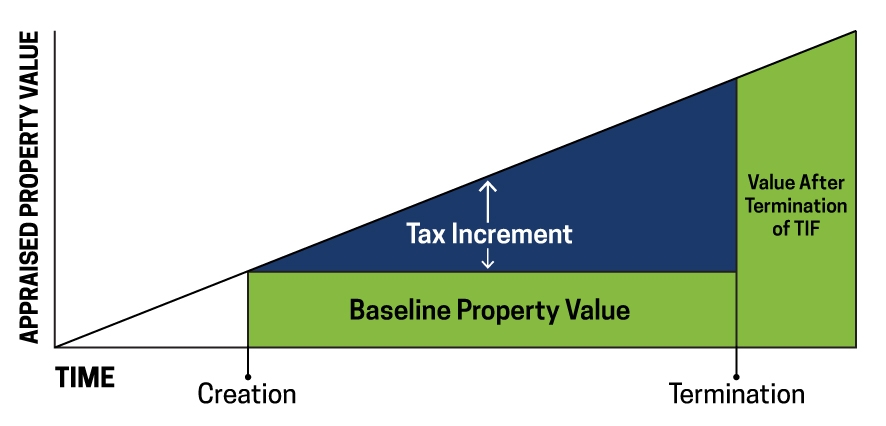
When a District is created, its Tax Increment Base is established in accordance with Alabama law. Each tax year thereafter during the life of the District, the Revenue Commissioner distributes local property tax revenues above the Tax Increment Base to the District’s TIF Fund to be used for authorized Project Costs under the approved Project Plan.
The TIF Fund grows as the District’s local property taxes exceed the Tax Increment Base.
Does establishing a TIF District increase property tax rates?
No. Establishing a TIF District does not increase either property tax rates or impact the amount of property taxes due on property in the District.
TIF Districts affect how the District’s local property taxes are distributed among local taxing authorities, while maintaining existing revenue to the local taxing entities.
During the life of a TIF District, a property owner’s tax bill may change because of a change in the assessed fair market value or a change in the assessment rate, but a TIF does not impact the tax rate.
How does a TIF District affect property tax revenue collected by the County or Board of Education?
A TIF District affects how increases in local property tax revenue above the Tax Increment Base are allocated among the County and the Board of Education, i.e., the local taxing authorities. The allocation depends on the type of district, the applicable statutory provisions, and any relevant agreements or governing documents.
During the life of a TIF, the County and Board of Education continue to receive existing real and personal property tax revenue from properties within its boundaries. However, the amount and timing of any increase in revenues are governed by the statutory rules for distributing local ad valorem taxes in a TIF District.
What types of projects may qualify for TIF funding, and is funding guaranteed?
Eligible projects depend on the approved Project Plan for the TIF District, and Alabama law controlling the use of public funds. Projects may include public improvements, infrastructure, streetscape enhancements, and other authorized improvements or activities that support development, redevelopment, rehabilitation, or revitalization.
Funding for Projects is not guaranteed. The Plan may authorize more Projects than it can fund. Proposed projects must satisfy applicable legal requirements, the approved Project Plan, and any required application, review, and approval procedures.
Funding depends on the District’s governing documents, available resources, and applicable approval requirements.
How long does a TIF District last, and what legal requirements govern the use of its funds?
The duration of a TIF District is established in the resolution that creates it, subject to the limits and requirements of Alabama law. Generally, the maximum duration depends on the type of district and use of the funds.
TIF expenditures must comply with the Project Plan, qualify as Project Costs under State law, and expend public funds in compliance with the Alabama Constitution.